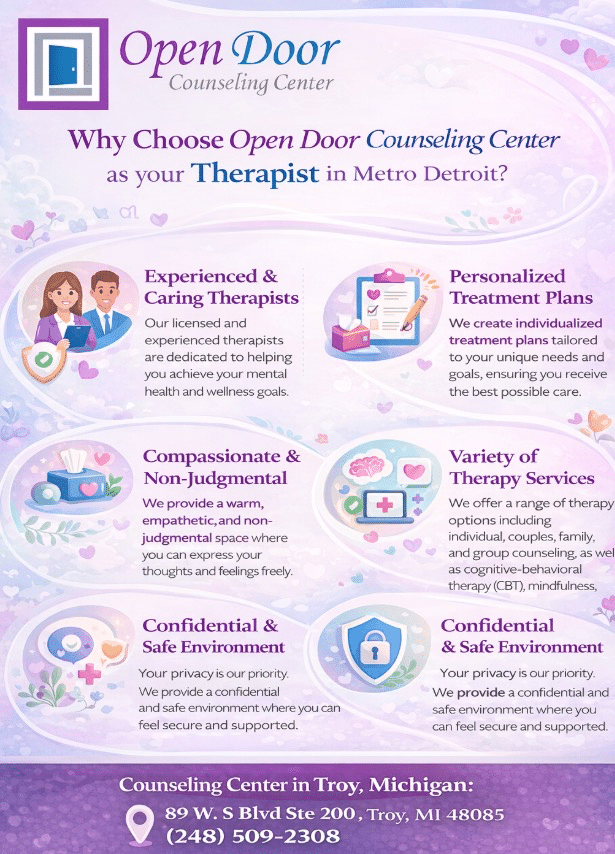
Therapist in Metro Detroit, Michigan

If you’re looking for a therapist in Metro Detroit, you’ll want care that’s culturally responsive, evidence-based, and practical for your schedule.
You might be managing anxiety, grief, parenting stress, burnout, or family conflict—and wondering how to choose the right fit.
At Open Door Counseling Center, we can help you assess the timing and impact of your symptoms, vet credentials, compare in-person and telehealth options, set measurable goals, and understand costs and local resources in Clinton Township and Troy, Michigan.
Key Takeaways
- Identify your needs (anxiety, family conflict, grief, parenting stress, burnout), their intensity, and impact to choose individual, couples, or child/teen therapy.
- Verify Michigan licensure (LLP, LPC, LMSW, LMFT, PsyD, PhD) and specialties matching your concerns, plus evidence-based methods like CBT, EMDR, EFT, or Play Therapy.
- Decide between in-person and teletherapy based on convenience, privacy/tech needs, and clinical fit; consider a hybrid approach and reassess after a few sessions.
- Clarify costs and insurance: fees, deductible, copay/coinsurance, session limits, sliding scale, HSA/FSA, superbills, and written fee policy.
- Use trusted local resources: Psychology Today, Inclusive Therapists, TherapyDen, NAMI Metro Detroit, United Way 2-1-1, and Open Door Counseling Center in Clinton Township and Troy, Michigan.
Understanding Your Therapy Needs in Metro Detroit
Even if you’re not sure where to start, noticing what’s hardest right now helps you choose the proper support in Metro Detroit.
Name the main pain point: anxiety spikes, family conflict, grief, parenting stress, or burnout. Clarify when it shows up, how intense it feels, and how it affects work, school, or relationships. You’re not diagnosing; you’re mapping patterns.
Consider who’s involved. Do you need individual therapy, couples work, or support for a child or teen? Note safety concerns like self-harm thoughts or severe withdrawal—those call for prompt help.
Identify practical needs: evening or Saturday hours, location in Clinton Township and Troy, Michigan, or culturally responsive care. Set realistic goals—reduce panic, improve communication, or stabilize routines.
Small, measurable steps guide steady progress.
How to Evaluate Therapist Credentials and Specialties
Before you book a session, check whether a therapist’s training and focus align with your goals.
Verify state licensure (LLP, LPC, LMSW, LMFT, PsyD, PhD) and confirm supervised clinical hours. Review specialties—trauma, couples, child therapy, eating disorders—and ask what evidence-based methods they use (CBT, EMDR, EFT, Play Therapy, Prepare & Enrich). You’re serving others best when you model careful due diligence and culturally responsive care.
In-Person vs. Teletherapy: Choosing the Right Format
When choosing between in-person sessions in Metro Detroit and teletherapy, you’ll want to balance convenience and accessibility with your need for privacy, comfort, and therapeutic fit.
Research shows both formats can be equally effective, so consider your schedule, commute, home setup, and whether you feel safer and more focused at home or in an office.
You can also try a hybrid approach and reassess after a few sessions to see what best supports your goals.
Convenience and Accessibility
From busy weekdays to unpredictable family schedules, choosing between in-person therapy and teletherapy should fit your life—not the other way around.
If you’re balancing service, caregiving, or shift work, access matters. In-person sessions offer structure and a change of setting; teletherapy reduces travel, expands therapist options, and keeps momentum when life gets hectic. Research shows both formats are effective for anxiety, depression, and relationship stress when you’re engaged and consistent.
Consider what supports your follow-through:
- Commute and time: Can you reliably reach Clinton Township and Troy, Michigan, during office hours, or do evening tele-sessions keep you consistent?
- Technology: Do you have a private space and stable internet for video?
- Clinical needs: Do you benefit from hands-on methods (e.g., child play therapy) best delivered in person?

Privacy, Comfort, and Fit
Although both options can work well, the right format often comes down to where you feel safe, seen, and able to open up.
If privacy at home is tricky—roommates, kids, thin walls—in-person may feel more secure. If driving, mobility, or health concerns make travel hard, teletherapy can reduce barriers and still deliver strong outcomes.
- In-person: richer nonverbal cues, ritual of the office, fewer tech issues.
- Teletherapy: flexible, discreet from your car or office, research-supported for anxiety, depression, and couples work.
You can also blend formats. We’ll help you choose a fit that honors your values, goals, and safety.
What to Expect in Your First Therapy Sessions
Even before you sit down, we aim to make your first sessions feel clear, respectful, and cooperative. You’ll share what brings you in, and we’ll ask focused questions about your history, strengths, and current stressors.
Jointly, we’ll define goals that align with your values and the people you serve. We use evidence-based approaches—such as CBT, EFT, and play therapy for kids—tailored to your needs and culture.
Clear, respectful first sessions: your story, focused questions, shared goals, evidence-based care tailored to you.
1) You set the pace. We won’t force disclosure; we’ll prioritize safety, dignity, and informed consent.
2) You’ll leave with a preliminary plan—what we’ll work on, how often we’ll meet, and what’s helpful between sessions.
3) You’ll notice clear boundaries and compassion. We track progress, adjust methods responsibly, and invite feedback so therapy remains collaborative and effective.
Cost, Insurance, and Sliding Scale Options
You earn clarity not just about the therapy process, but also about what it costs and how payment works.
In Metro Detroit, most clinicians share fees upfront, outline insurance options, and offer good-faith estimates.
You’ll typically pay per session, with receipts (superbills) for out-of-network reimbursement. If you serve others, you know transparency builds trust—we practice it, too.
- Verify your benefits: deductible, copay/coinsurance, and session limits.
- Ask about a sliding scale based on income or hardship.
- Consider HSA/FSA for pre-tax savings.
- Request a written fee policy and cancellation terms.
Trusted Local Directories and Community Resources
When you’re ready to find care or supplement therapy with community support, start with reputable local directories and vetted resources.
You’ll save time, reduce risk, and find providers aligned with your values of service and equity. Prioritize platforms that verify licenses, list specialties, and show real availability.
- Use trusted directories: Psychology Today, Inclusive Therapists, TherapyDen, and your insurance portal filter by license, culture, language, sliding scale, and telehealth.
- Tap local networks: United Way 2-1-1, NAMI Metro Detroit, MI Bridges, school counselors, faith-based care ministries, and community health centers provide referrals and low-cost options.
- Check Meto Detroit resources: Open Door Counseling Center offers evidence-based care for adults, couples, and youth, with culturally responsive services.
Verify credentials on Michigan’s LARA license lookup, read informed-consent policies, and confirm crisis pathways before you begin.
You’re not alone in seeking support. In Metro Detroit, you can choose a therapist who matches your goals, culture, and schedule—whether in-person or via teletherapy.
Consider reaching out to the Open Door Counseling Center for Guidance
Ask about credentials, specialties, and evidence-based approaches, and expect collaborative goal-setting, informed consent, and clear safety planning. Clarify fees, insurance, or sliding-scale options upfront.
If needed, request referrals or community resources in Clinton Township and Troy, Michigan. Taking the first step is brave—and with the right fit, you’ll build skills, reduce distress, and improve daily functioning.
Schedule Your Free 20-minute Consultation Today with Open Door Counseling Center
Contact us today for your appointment request.
Clinton Twp (586) 203-2715 • Troy (248) 509-2308 • Text (586) 330-9415
Email Us HereContact Us:
Open Door Counseling Center – Troy MI
(586) 203-2715
89 W South Blvd #200, Troy, MI 48085
Related Searches: