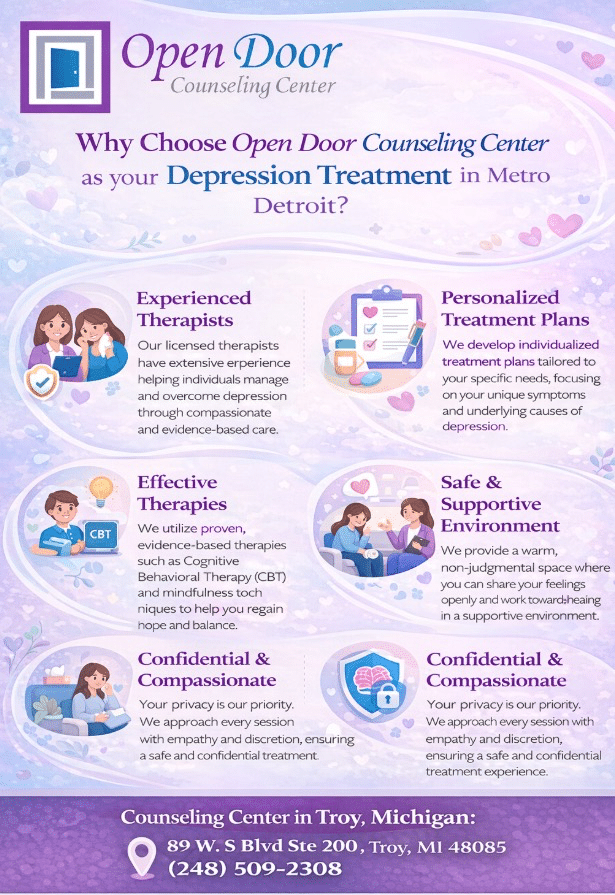
Depression Treatment in Metro Detroit

If you’re facing low mood, fatigue, or loss of interest, you’re not alone—and effective help is available in Metro Detroit.
At Open Door Counseling Center, you can choose evidence-based therapy like CBT or IPT, medication with a psychiatrist or primary care clinician, and convenient options such as teletherapy or evening appointments.
For more challenging cases, TMS and ketamine/esketamine may help. Costs, insurance, and access vary—but with the proper guidance, you can map a plan that actually works for you…
Key Takeaways
- Evidence-based therapies available: CBT, Behavioral Activation, IPT, MBCT groups, and trauma-focused options like TF-CBT and EMDR across Metro Detroit.
- Medication management offered by psychiatrists, NPs, and PCPs using SSRIs/SNRIs/bupropion/mirtazapine with start-low, go-slow follow-ups every 2–6 weeks.
- Innovative treatments include TMS and ketamine/esketamine for treatment-resistant depression, plus teletherapy/telepsychiatry, evening, and Saturday hours.
- Find providers via Psychology Today, insurer directories, health systems, or the Open Door Counseling Center in Clinton Township (586-203-2715).
- Verify licensure, evidence-based modalities, insurance coverage, CPT codes, telehealth access, and ask about sliding-scale or out-of-network superbills.
Understanding Depression and When to Seek Help
Although sadness is a normal human emotion, depression is a medical condition that persists and impairs daily life.
You might notice low mood most days, loss of interest, sleep or appetite changes, fatigue, slowed thinking, guilt, or hopelessness lasting two weeks or more.
Depression can also show up as irritability, physical aches, or trouble concentrating. It’s not a weakness; it’s a treatable health condition influenced by biology, stress, and environment.
Seek help promptly if symptoms interfere with work, caregiving, or relationships; if you’re using alcohol or substances to cope; or if you have thoughts of self-harm. If there’s imminent risk, call 988 or emergency services.
Early assessment by a licensed clinician supports safety, restores functioning, and helps you continue serving others with steadiness and compassion.
Evidence-Based Therapies Available in Metro Detroit
When you’re ready to move forward, Metro Detroit offers proven, accessible treatments for depression delivered by licensed clinicians. You’ll find cognitive-behavioral therapy (CBT) to target negative thought patterns, behavioral activation to re-engage inmeaningful routines, and interpersonal psychotherapy (IPT) to improve relationship health.
For trauma-related depression, clinicians provide trauma-focused CBT and EMDR. If rumination drives symptoms, mindfulness-based cognitive therapy (MBCT) builds present-moment skills.
For severe, treatment-resistant cases, clinics offer transcranial magnetic stimulation (TMS) and evidence-based group therapy to strengthen skills and social support.
Open Door Counseling Center provides CBT, trauma-informed care, Play Therapy for children, and teen-focused interventions, all delivered by licensed therapists attuned to cultural and family contexts.
Evening and Saturday hours increase access so you can receive timely, consistent care and serve others sustainably.
Medication Management and Psychiatric Care Options
You can pair psychotherapy with medication to reduce depressive symptoms, improve function, and prevent relapse.
Pair psychotherapy with medication to ease depression, boost function, and lower relapse risk.
In Metro Detroit, you’ll find psychiatrists, psychiatric nurse practitioners, and primary care physicians who prescribe evidence-based options like SSRIs, SNRIs, bupropion, and mirtazapine.
A careful evaluation reviews symptoms, medical history, sleep, substance use, and suicide risk. You’ll discuss benefits, side effects, interactions, and a safety plan.
Expect start-low, go-slow dosing, with follow-ups every 2–6 weeks to assess response and tolerability. Most antidepressants need 4–6 weeks for effect; remission is the goal, not partial relief.
If you respond, continuation for at least 6–12 months reduces relapse; longer maintenance helps with recurrent episodes.
At Open Door Counseling Center in Clinton Township and Troy, Michigan, we coordinate closely with prescribers and support adherence, monitoring, and collaborative care.
Innovative Treatments: TMS, Ketamine, and Virtual Care
Sometimes standard treatments need a boost, and Metro Detroit offers innovative options that can help. If you’ve tried medications or therapy without enough relief, Transcranial Magnetic Stimulation (TMS) may be appropriate.
TMS uses targeted magnetic pulses to stimulate underactive mood circuits; it’s noninvasive, performed in-office, and typically well-tolerated, with minimal side effects such as scalp discomfort.
For treatment-resistant depression, ketamine or esketamine can rapidly reduce symptoms by modulating glutamate and enhancing neuroplasticity.
You’ll complete careful screening, monitored dosing, and follow-up to sustain gains and promote safety.
You can also expand access with virtual care. Telepsychiatry and teletherapy provide evidence-based treatment, crisis-sensitive check-ins, and collaborative care plans—particularly helpful for caregivers, shift workers, and mobility-limited clients.
These modalities let you serve consistently while protecting your own well-being.
Finding Providers, Insurance Coverage, and Costs
From first search to first session, finding effective depression care in Metro Detroit works best with a clear plan: identify your needs, verify credentials, and confirm fit, access, and cost.
From search to session, navigate Metro Detroit depression care with clear priorities, verification, and cost-fit checks.
Define priorities: psychotherapy, medication management, or both. Search Psychology Today, insurer directories, and health systems; include local options like Open Door Counseling Center.
Verify licensure (LMSW, LPC, PsyD, PhD, MD/DO), specialty in depressive disorders, and evidence-based modalities (CBT, IPT, ACT). Ask about measurement-based care (PHQ-9), telehealth, evening hours, and language/cultural match.
Call your insurer to confirm in-network status, copays, deductibles, visit limits, and referrals. Request CPT codes (90791, 90834/90837, 99213/99214) and prior authorization needs.
If out-of-network, ask about superbills and sliding-scale rates. Clarify cancellation policies and payment options before scheduling.
Community Resources, Support Groups, and Crisis Services
While professional treatment anchors recovery, community resources in Metro Detroit can reinforce your progress, reduce isolation, and provide timely support.
You can weave these options into your care plan to expand coping skills, foster a sense of belonging, and respond early to symptom spikes.
- Join peer support: Consider NAMI Metro Detroit groups, DBSA meetings, and faith-based or culturally specific circles.
- Peer-led formats reduce stigma and improve adherence to care.
- Leverage local services: Libraries, parks, and community centers offer movement classes, mindfulness groups, and volunteer opportunities that build routine and meaning.

Open Door Counseling Center in Clinton Township and Troy, Michigan, provides evidence-based therapy across the lifespan and welcomes nearby communities.
Know crisis pathways: If risk escalates, call 988, text 741741, or reach the Macomb County Crisis Center.
For imminent danger, call 911 and request a CIT-trained officer.
You don’t have to navigate through depression alone. When symptoms impact your work, relationships, or safety, it’s important to reach out.
In Metro Detroit, you have access to a range of effective treatments, including proven therapies like CBT and IPT, medication management, and if necessary, TMS or ketamine/esketamine. Utilize tools such as PHQ‑9 tracking, teletherapy, and flexible hours to integrate care into your life seamlessly.
Check your insurance coverage, inquire about sliding-scale fees, and consider resources such as NAMI, DBSA, and Open Door Counseling Center.
If you find yourself in crisis, don’t hesitate to call or text 988 or visit a local crisis center right away.
Schedule Your Free 20-minute Consultation Today with Open Door Counseling Center
Contact us today for your appointment request.
Clinton Twp (586) 203-2715 • Troy (248) 509-2308 • Text (586) 330-9415
Email Us HereRelated Searches: