Couples Counseling in Metro Detroit, Michigan

In Metro Detroit, you’re juggling long commutes, shifting work demands, and blended-family rhythms that strain connection.
Couples counseling at Open Door Counseling Center helps you map patterns—criticism, shutdowns, emotional distance—and replace them with evidence-based tools from EFT, Gottman, and IBCT.
You’ll set clear goals, practice repair strategies, and align daily choices with shared values, all within a trauma-informed, culturally responsive care framework.
If you’re wondering what those first sessions look like—and how to pick the right therapist—here’s what matters next.
Key Takeaways
- Metro Detroit couples seek counseling for recurring conflict, emotional distance, work/commute stress, family pressures, and cultural or interfaith differences.
- Evidence-based methods include EFT, Gottman Method, IBCT, with trauma-informed, culturally humble, values-guided care.
- First sessions set goals, map interaction patterns, assess strengths/stressors, and create a practical, measurable treatment plan.
- Therapists should be licensed, LGBTQ+-affirming, and faith-sensitive; ask about EFT/Gottman/IBCT training and session structure, fees, and telehealth.
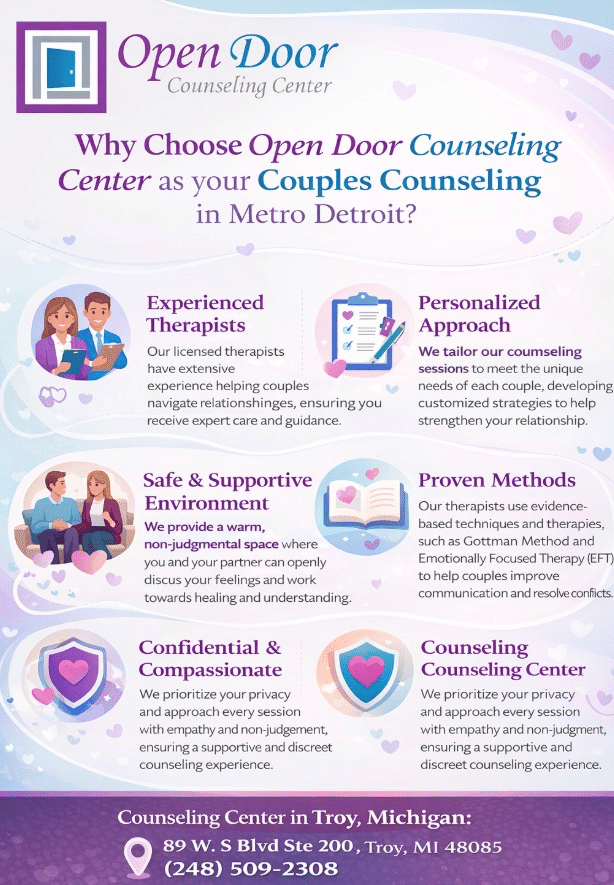
- Local options include Open Door Counseling Center in Clinton Township and Troy, Michigan; schedule consults to assess fit, availability, and approach.
Why Couples Seek Counseling in Metro Detroit
Even in strong relationships, stressors in Metro Detroit—workload, commute time, family pressures, and cultural or interfaith differences—can strain connection and communication.
You might notice recurring arguments, emotional distance, or cycles of criticism, defensiveness, and withdrawal. When stress rises, couples often slide into reactive patterns that erode trust and reduce empathy.
You may seek counseling to realign values, clarify roles, and strengthen teamwork around parenting, finances, or in-law dynamics. Blended family adjustments, step-parent authority, and co-parenting arrangements can add complications.
Some couples come to decide whether to repair, redefine, or thoughtfully separate. Others want to address infidelity injuries, rebuild safety, and restore intimacy.
If you’re service-minded, counseling helps you lead with care, set healthy boundaries, and create rituals that keep your relationship resilient and responsive to your community’s needs.
Evidence-Based Approaches Therapists Use
While every couple’s story is unique, our therapists rely on proven methods that target how your relationship system functions under stress.
We use structured, research-backed models to de-escalate conflict, strengthen attachment, and align daily behaviors with shared values.
You’ll practice concrete skills that improve feedback loops between emotion, communication, and repair—so you can serve each other and your community with steadier hearts.
We also integrate trauma-informed care, cultural humility, and values-guided goal setting. Each tool fits your system’s needs, not the other way around.
What to Expect in Your First Sessions
You’ve seen the frameworks we use; now, here’s how the process starts. In your first session, you’ll outline goals that serve the relationship, not just individual preferences.
We’ll map your interaction patterns, identify stuck cycles, and gather a brief history of your strengths, stressors, and support systems. You’ll leave with a shared plan and initial tools to de-escalate conflict.
Next, we complete structured assessments and clarify values, roles, and boundaries. We’ll observe your communication in real time, coach small shifts, and assign tailored practice between sessions. If safety or affairs are present, we stabilize first and pace treatment accordingly.
Across these early meetings, you can expect clear objectives, measurable feedback, and respect for culture and family systems. The focus stays collaborative, hopeful, and practical.
Finding the Right Therapist for Your Relationship
Because the therapist becomes part of your relationship’s system, choose someone who fits your goals, values, and identities and uses methods with proven outcomes.
In Metro Detroit, look for clinicians trained in modalities like EFT, Gottman, or IBCT who attend to culture, faith, sexuality, and family structure.
Ask how they collaborate with both partners, track progress, and align care with your shared mission to serve each other and your community.
- Verify training, licensure, and supervision; ask about EFT, Gottman, or IBCT certifications.
- Seek inclusivity: LGBTQ+-affirming, culturally responsive, and faith-sensitive care.
- Clarify structure: conjoint and individual sessions, goals, length, and outcome measures.
- Evaluate fit: Do you both feel heard, safe, and challenged toward growth?
- Consider access: scheduling, fees, telehealth, and options like Open Door Counseling Center.

Addressing Common Challenges: Communication, Trust, and Conflict
With the right therapist in place, the work turns to the patterns that keep you stuck—how you communicate, how you repair trust, and how you handle conflict. You’ll map cycles, not villains: bids for connection, missed signals, escalations, and withdrawals. We’ll slow conversations, track triggers, and link emotions to needs so you both feel heard without blame.
Trust rebuilding follows a clear, accountable process. You’ll name injuries, validate impact, and create transparent agreements that restore safety. When attachment injuries or infidelity are present, we’ll pace disclosure and repair using research-backed steps.
Conflict shifts from win/lose to problem-solving. You’ll differentiate solvable issues from gridlocked ones, regulate arousal, and re-enter dialogue with curiosity. In Metro Detroit, this system’s lens helps you serve each other—and your wider community—through healthier relating.
Practical Tips to Strengthen Your Relationship Between Sessions
Often, progress accelerates when you practice small, structured habits between sessions. Use simple, repeatable routines that align with your goals and values. Aim to notice patterns, reduce escalation, and create safety. Focus on what’s measurable, collaborative, and respectful—especially when you both serve others and carry high stress.
Small, repeatable habits build safety, reduce escalation, and accelerate progress under high stress.
- Schedule a 10-minute daily check-in: share one feeling, one need, and one appreciation; listen without fixing.
- Use time-outs: agree on a signal, pause for 20–30 minutes, then return with a softened tone and one solvable point.
- Practice “state the story, then the data”: separate interpretations from observable facts to reduce blame.
- Map triggers jointly: identify cues, body signals, and de-escalation steps.
- Protect rituals of connection: two weekly dates (one fun, one logistics) to maintain momentum.
Conclusion
You don’t have to find your way through Metro Detroit’s stressors alone. With an evidence-based, systems lens, you and your partner can map patterns, reduce reactivity, and rebuild a secure connection at Open Door Counseling Center. In counseling, you’ll set shared goals, practice skills between sessions, and align daily behaviors with your values. As trust grows, conflict becomes a signal—not a crisis—and you collaborate more effectively. Choose a therapist who fits your culture and needs, and commit to the process. Small, consistent repairs create lasting change.
Schedule Your Free 20-minute Consultation Today with Open Door Counseling Center
Contact us today for your appointment request.
Clinton Twp (586) 203-2715 • Troy (248) 509-2308 • Text (586) 330-9415
Email Us Here